
Artificial Intelligence: What is it and what’s its ecological footprint?
A few days ago I stumbled across an article titled Is Everyone Really Dating AI Chatbots? I was surprised, but not as much as I thought I should be. In reality, as of December 2025, we can safely state that Artificial Intelligence has pervaded our society and seems to be everywhere. It is embedded in search engines, it powers digital assistants, it threatens to replace many jobs, even younger generations use it as their psychotherapists. Having AI romantic companions is actually just another milestone, and actually not really an unexpected one.

What is in fact quite baffling to me is that the first mainstream-accessible generative artificial intelligence was released only in November 2022. Today, three years since that release, I struggle to imagine a world before AI. Already back then it became clear to me that we had hit a civilization-wide inflection point, such as the invention of the steam engine, or the internet.
I actually wrote an article in December of that same year where I reflected: “I believe we might be at the doorstep of yet another civilization leap, as close to the poly crisis as we are. Watching this bot in action has ‘made me ponder about its implications. How many jobs will soon become obsolete? Will AI be able to provide some ingenious answers to our several problems? At the beginning of the 90s nobody could have predicted how impressively internet would be woven into our lives nowadays, even in our remote, eco-communities. Will ChatGPT be an inflection point towards a future nobody can imagine, or will this impressive feat fade after a while. I, for once, am surprisingly excited about this development.”
Three years have passed, during which I’ve dedicated quite some time to study and reflect on AI’s evolution. As a continuation of the Ethical Digital Culture article series, in the next two articles we dive into the world of Artificial Intelligence to tackle some of what I consider to be the key questions around AI: What is AI? Is it sustainable? And ethical? How does it reshape geopolitics, and what potential futures could be ahead of us?
What is actually Artificial Intelligence and how does it work?
The widely accepted definition of Artificial Intelligence is: Artificial intelligence (AI) is technology that enables computers and machines to simulate human learning, comprehension, problem solving, decision making, creativity and autonomy.
But how does that simulation happen? Are machines truly able to think? In order to answer that question, we need to understand in more detail the technologies behind it and its evolution in time.
We already find tales of Talos, a thinking automaton in greek mythology, but it’s not until the 1950, when Alan Turing publishes the paper Computing Machinery and Intelligence, where he poses the question whether machines can think, and he presents the famous “Turing Test”, where a human interrogator would ask questions, and a machine would succeed if the interrogator cannot tell whether the answers come from an actual human being. If the simulation of thought is good enough to fool a human being, can we still talk about a simulation?
The next big milestone towards nowadays Artificial Intelligence was the introduction of machine learning and more concretely neural networks. Machine learning, in short, means that machines are able to learn from data without being explicitly programmed. A good example of how to accomplish that is neural networks (a specific type of machine learning). Instead of programming a single complex large piece of code, multiple simpler units (neurons) are programmed and executed all at once, mimicking how a human brain would work. Then this brain is trained by providing it with a large set of input data and expected outcomes. This is also known as supervised training. Once trained through several iterations, the brain can then provide new outcomes if new input is provided.
During the 2010’s, neural networks were enhanced exponentially by the introduction of deep learning. Until deep learning algorithms were invented, neural network training happened through supervised training. Deep learning uses several layers of neural networks and uses unsupervised training, which does not require of human intervention, and thus, enhances the training capabilities manifold.
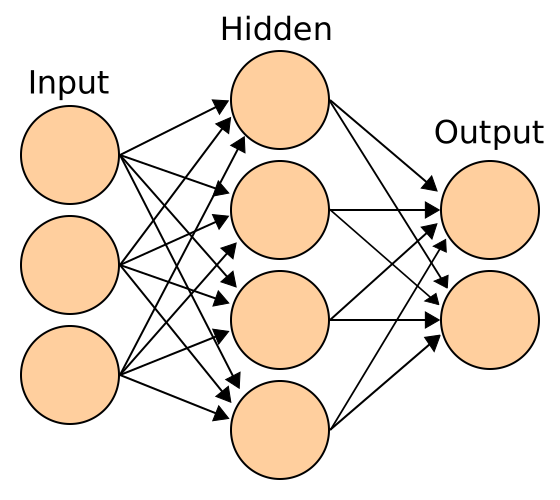
en:User:Cburnett, CC BY-SA 3.0, via Wikimedia Commons
In a deep neural network, multiple layers of nodes can extract meaning and relationships from large volumes of unstructured, unlabeled data.
The last big step towards what we commonly refer today as artificial intelligence happened in the early 2020’s with the appearance of Large language models. This last piece of the puzzle made deep neural networks “capable of understanding and generating natural language and other types of content to perform a wide range of tasks”.
You might probably be familiar with the rest of the story. Since the appearance of ChatGPT in 2022, made widely available, many other companies have also produced their own generative artificial intelligence models, which have grown ever since more complex and capable.
In summary, machines do not think yet, per se, but have gotten extremely good at simulating human thought and they have access to mostly all online available data. I’m sure many of us could be already having a hard time discerning AI from human in some cases. AI is considered to have passed the Turing test as of 2025 by some pundits.
How sustainable is AI?
As we approach the end of 2025, we have normalized as a society seeing AI everywhere. From students using chat bots to write their essays, to nearly every imaginable business sector integrating it into their workflows. However, while many jump into this hype wagon, praising all the benefits of using AI, it is far less common to hear voices questioning how sustainable and ethical it is to use AI.
Some of you might have read already about vast electricity and water consumption associated to AI, but do we know what’s actually behind those claims?
Prompting an AI chat-bot uses roughly 10 times more energy overall than e.g. performing a traditional internet search. Being image, music, or especially AI video generation much more energetically strenuous. At the same time, AI generation is increasingly being embedded in many automated processes, making its consumption explode because of up-scaling.
However, the most energy consuming part of AI is the training of LLM models. E.g. OpenAI’s GPT-3, one of the older and simpler models released back in 2020, required 1,287 MWh (megawatt-hours) of electricity for training — enough to power 100 average U.S. homes for a year. Newer, exponentially more powerful models, have required exponentially more energy to be trained.

BalticServers.com, CC BY-SA 3.0, via Wikimedia Commons
Both the training and hosting of AI systems is done in massive data centers across the globe (cloud computing). These data centers require lots of energy to run, and water to cool down. The exact amount remains unknown due to insufficient data provided by the companies running them (due to lack of proper legislation that would force certain information to be made public). In a recent article, using an approximation through data centers’ general performance metrics, it is stated that Company-wide metrics from the environmental disclosure of data center operators suggest that AI systems may have a carbon footprint equivalent to that of New York City in 2025, while their water footprint could be in the range of the global annual consumption of bottled water.
Additionally, we also have to consider the amount of raw materials needed to produce the electronic equipment used in data centers, regularly being updated with newer and faster hardware and the consequent hazardous electronic waste that this whole cycle produces.
These estimations are so far away from human scale that are very difficult to grasp. But they unequivocally indicate that despite all perceived benefits that generative AI bring to the table (which is also in itself part of another debate) one thing becomes clear: there are not enough resources that could support such a growth rate for long. Even current resource consumption cannot be sustained unless there is a clear benefit from using AI. And here is where we enter into uncharted territory, as we don’t know whether eventually an AI system will be able to help us improve efficiency or provide us with new tools in such a way that the global accumulated footprint is reduced. As of today, it feels like a very big planetary gamble to me, and it does not show signs of slowing down (as we will see in part 2).
Is there actually something that can be done? We will discuss the geopolitics of AI in part 2, but for now, with regards to sustainability, the UN Environment Programme has four clear proposals to attempt to mitigate what they call the environmental fallout from AI which I think are definitely steps that need to be taken, at the very least to understand the scale of this planetary gamble.
- Countries can establish standardized procedures for measuring the environmental impact of AI
- Governments can develop regulations that require companies to disclose the direct environmental consequences of AI-based products and services
- Tech companies can make AI algorithms more efficient
- Countries can encourage companies to green their data centres, including by using renewable energy and offsetting their carbon emissions
- Countries can weave their AI-related policies into their broader environmental regulations
Now that we’ve explored what AI is and the heavy trail it leaves on the Earth, it’s time to look at the global stage. Beyond the physical footprint lies a complex web of ethical dilemmas and global power dynamics. Who truly controls these systems, and how are they reshaping our societies? Join us for Part 2, where we will dive into the geopolitics of AI and look ahead at the different paths our digital future might take—asking how we can steer these technologies toward a more regenerative and ethical horizon.