Community Beyond Escape
Ecovillages: Islands of Privilege or Agents of Collective Liberation?
By Martin Winiecki, July 2026 – expanded and edited version of a talk given at the European Ecovillage Gathering 2026.
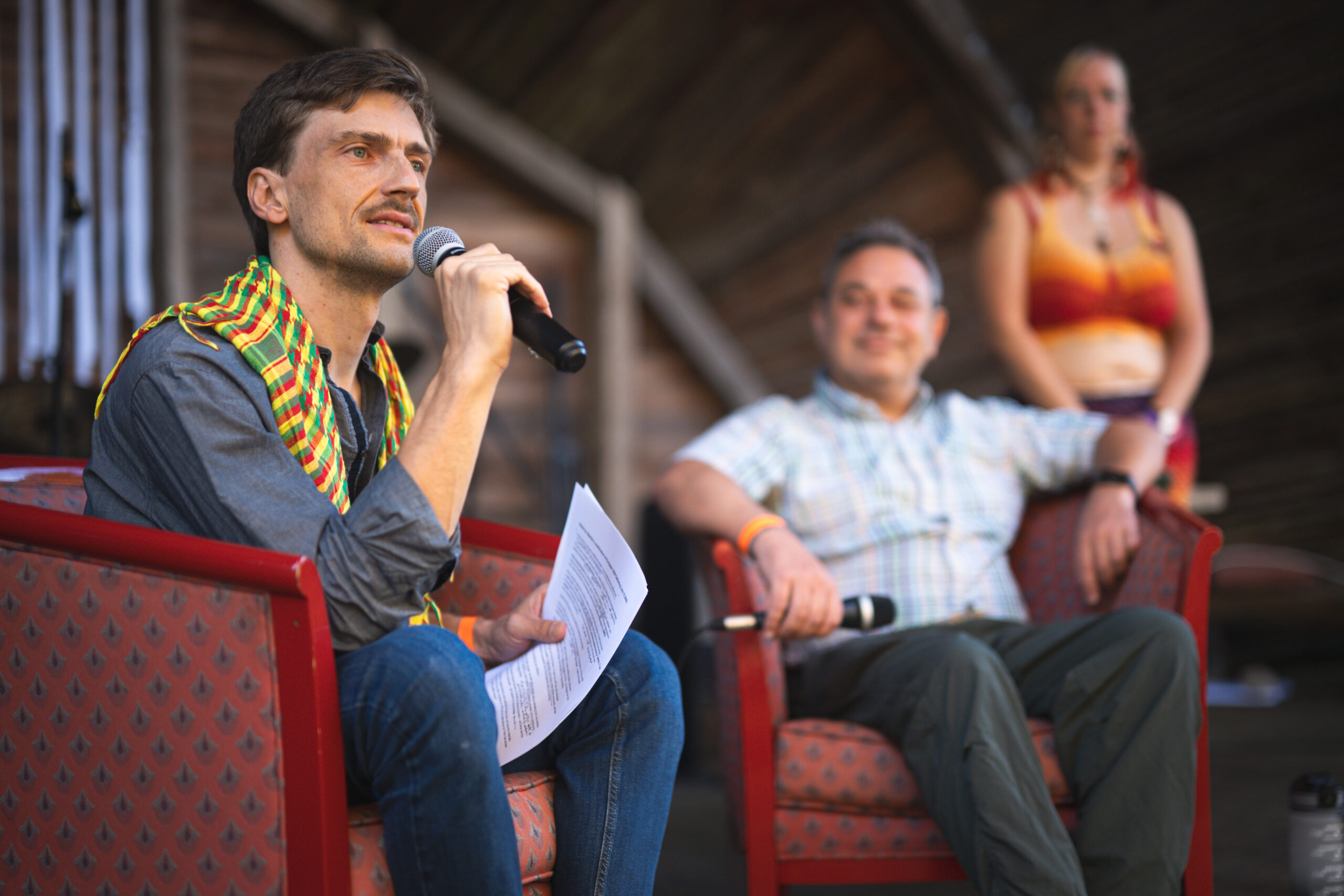
Community is not just a relational project – it’s a historical and political one.
That’s to say that building and maintaining community today means doing so in the midst of ecological collapse, growing inequality, spreading fascism and neocolonial brutality.
These aren’t separate crises but culminations of centuries of modernity, coloniality and capitalism, and millennia of patriarchal dominator culture. These and other catastrophes derive from the core logic of these systems – that is, their drive for ever growing accumulation through violent dispossession and extraction.
The result is an increasingly unlivable world. Housing becomes unaffordable. Wars, genocides and extreme weather force more and more people to flee. Floods, droughts, heat waves and cold disrupt agricultural production and drive up food prices. Wealth concentrates in ever fewer hands while social protections are dismantled. Unless current trends are reversed, we could face a reality of mass poverty while ecological breakdown accelerates.
Against this backdrop, two very different responses are emerging.
One is what Naomi Klein and Astra Taylor call end-times fascism. The mindset is: As the world is ending, let’s barricade ourselves and those we consider “like-minded” in survivable islands of privilege.
We can already see versions of it: billionaire bunkers, gated communities, lethally fortified borders, fantasies of migrating to Mars. It’s a politics of escape from the poor, from those fleeing collapse, and ultimately from responsibility itself. One defined by an increasingly explicit logic of ruthless supremacy.
I don’t think this logic will stop at bunkers. I’m quite sure we’ll also see ecological alternatives built for the wealthy. Regenerative communities inside fortified compounds, perhaps in Iceland or Patagonia, accessible only to those deemed worthy of surviving.
The alternative is something very different.
Meeting collapse not with escape, but with radical solidarity. Not by retreating from one another, but by deepening our capacity to stick together. Not by protecting privilege, but by collectivizing care, resources and responsibility.
Whether we move towards fascism or collective liberation – and what role this movement plays at that crossroads – will depend on several things.
One of them is whether a regenerative post-capitalist infrastructure can become materially relevant at scale before it’s too late. Another is: Who has access to and agency in our alternatives?
Who are our alternatives for?
I find that the ecovillage movement needs an honest self-assessment here: To what extent do our communities serve collective liberation? And to what extent are they actually islands of privilege themselves, even if not intentionally?
I’m raising this question as someone with a lot of privilege myself. I’m a white German cis-man from a middle-class background who was in a leadership position in a majority white middle class community, and simultaneously as an anarchist who has worked for intersectional justice for years.
I’m assuming that what I’m about to say is likely to some extent still compromised by my own power and privilege. I feel it’s also important to acknowledge that I have benefited from and in some ways perpetuated the patterns of exclusion and harm I’m about to mention, while friends and others from marginalized backgrounds have (sometimes intensely) been impacted by them. I’m naming them with humility, hoping that this conversation – long overdue – can contribute to equity, repair and healing. The following is an invitation to self-reflect on how these patterns might play out in your own communities, how you might have been impacted by, but perhaps also benefited from and contributed to them, what you can do to interrupt harm and what I might have missed.
1) Intentional communities that don’t transform their bioregional context lack political relevance.
Many communities become isolated from their surroundings, with limited engagement in local culture, economies and struggles. Especially when communities are made up of people from more privileged socio-economic backgrounds than those around them, they can contribute to forms of cultural colonialism – for example by creating an alternative scene that competes with local culture or by accelerating rural gentrification, making life less affordable for local people.
This is also a consequence of our belief systems. If we have a theory of change that tells us we can save the world by building small communities, we might not feel incentivized to build meaningful relationships beyond the borders of our ecovillages.
I want to be frank here: If 20, 50 or 200 people figure out how to live together well, that’s incredibly valuable. But it doesn’t mean they’ve discovered a universal model that answers the crises of our time. Ecovillages alone will not save the world. And the fantasy of insular self-sufficiency will collapse together with the society it imagines it can escape.
If we want resilient food systems, for example, we need ecological regeneration at the bioregional scale. We need local economies and cooperation between different actors, groups and populations. Nothing in nature exists in isolation. Resilience emerges from a multiplicity of relationships across difference.
Rather than imagining intentional community as an all-encompassing answer to every crisis, I wonder: How can ecovillages catalyze the regenerative transformation of the specific local, bioregional, political, economic and cultural contexts they’re part of?
I also say this because believing ourselves to be superior to the “outside world” is the first step towards becoming a cult.
I know that’s polemical language, which has often been weaponized to initiate witch hunts against intentional communities. But I still find the C-word meaningful because it helps us put our fingers at a particular dynamic of toxicity and harm that’s so self-entrancing when you’re in it. For example, groups convinced that they’re on a “higher mission” of saving the world and that they therefore possess “The Truth” can easily slide into forms of group think where people surrender their own ethical judgement. That’s precisely where insularity, gaslighting, extraction and abuse become possible, especially when there’s a top-down power structure and charismatic leaders. I find that, as a movement, the ecovillage scene has long been too naive and permissive here.
2) Communal living alone doesn’t make you “post-capitalist” or democratic.
Many communities commodify the practice and knowledge of community living while reproducing or at least tolerating significant economic inequality internally. Access often depends on savings, inherited wealth or remote work. Increasingly, communities rely on volunteers who pay to work, often without meaningful protections. Under the language of community and gift economy, intentional communities can create deeply extractive arrangements that remain accessible mainly to people with privilege or leave less privileged people in very precarious situations.
What really matters here are the material realities: who makes economic decisions; how income and wealth are distributed; what impacts our ways of making money have – for example when they prioritize retreats and tourism over tending to more essential needs in the territory; and whether our economic arrangements actually bring us closer to the world we dream of.
As long as small groups call the shots and structural economic inequality remains intact, it isn’t post-capitalist. It’s just a different language.
3) Accessibility is a political question, not a diversity question.
Most ecovillages in Europe remain predominantly white and middle class. That’s not simply a coincidence. It’s the result of material and cultural barriers to entry.
Beyond economic exclusion, Black people and people of colour for example often encounter additional barriers: microaggressions, tone policing, exclusion from information and decision-making, tokenization, cultural appropriation, spiritual bypassing, and white fragility when they raise these experiences. Queer and disabled people face similar challenges.
Too often, the people naming harm become problematised rather than the harm itself, leaving those already coming from experiences of discrimination not rarely (re-)traumatized in what presents itself as a “new culture.”
Let’s face it: If people from marginalized groups don’t have agency in, can’t be well in, or don’t even have access to our spaces, then those aren’t radical or revolutionary – they reproduce the very structures of exclusion and hierarchy they claim to challenge.
There’s no escape from politics
Many majority-white, middle-class communities in the geopolitical North imagine themselves as already beyond capitalism or oppression simply because they live differently. I believe this exceptionalism is one of the most depoliticizing ideas we can have about ourselves because it blinds us to the ways that systems of oppression continue to shape our “alternative spaces.”
Many people get uncomfortable here. The impulse is often: “Yes, okay… but what’s the solution?”
I’m not saying we should spend our lives analysing systems – or that analysis alone makes us immune. But I am suggesting that the depth of our alternatives is proportional to our willingness to embrace the contradictions that inevitably come with building them.
It’s impossible to attempt post-capitalist ways of living without carrying capitalism, patriarchy and coloniality inside ourselves. Those contradictions are inevitable. The question is what we do about them. If we deny them, we become trapped inside them. But if we actually acknowledge and work with them, we can transform and evolve towards greater contextual relevance.
Politics concerns the organization of power: who decides, who belongs, whose needs matter, and whose knowledge counts – and politics is everywhere. There’s no social context, however small, in which people (and other beings) aren’t negotiating relations of power. Recognizing that all social reality is made up of choices and agreements means that we can question, reimagine and change those agreements to better tend to the needs of everyone involved. That’s why acknowledging that everything is in fact political is so liberating – and so uncomfortable at the same time.
Communal Practice of Collective Liberation
Making intentional communities with majority privileged groups more accessible and equitable isn’t easy. It requires humility, self-reflexivity, humour and patience. And above all, an ongoing shared commitment to building culture in service of collective liberation.
I celebrate every community, organization and network that commits itself to dismantling systems of oppression. But unless that commitment becomes visible in how power, resources and information are distributed, in practices of impact sharing, repair and accountability, and ultimately in a different organizational and relational culture, it remains just talk.

If we want communities that don’t simply reproduce the world we’re trying to leave behind, then transformation has to happen on at least three levels at once.
The first is structural. To notice the material outcomes of our communities beyond our intentions.
Who has access to our spaces? Who makes decisions? Who controls land, resources, hiring and information? Who gets paid and who doesn’t? Who carries invisible labor? Can people with the least power speak freely and safely about their experiences? Does feedback flow upwards? How do we approach conflict, repair and accountability? How healthy, happy and loving are the people involved? And beyond the human community: How are the land, waters and more-than-human beings affected? Are we caring for the ecosystems that sustain us?
Unequal outcomes are rarely accidental. They usually emerge from structures that systematically produce them. The question, then, is not only what outcomes we observe, but which agreements, institutions, habits and economic arrangements create them – and how we might realign them with our values.
Structural inquiry inevitably brings us to privilege – not as a personal flaw but as a structural and relational phenomenon. Privilege isn’t simply about having more. It is about institutional, legal, political, economic, cultural and social arrangements that provide unearned advantages to some while systematically denying them to others. Seeing that clearly can be painful because it confronts us with the fact that many of our opportunities have been made possible through histories and structures that constrained these opportunities of others.
Structural change therefore asks more than a change in language. It asks those of us who benefit most from existing arrangements to relinquish power, redistribute resources and redesign the structures themselves.
Looking at privilege structurally also widens the scale of our inquiry. The relative wealth and security enjoyed by many of us in the geopolitical North are inseparable from centuries of brutal colonial extraction and from an economic system that continues to rely on profoundly unequal exchange. Much of the prosperity we in Europe take for granted still depends upon the exploitation of labor, land and resources elsewhere, enabled through trade regimes, debt, ecological devastation and the continued erasure and displacement of Indigenous peoples and communities of resistance.
This raises a question that, in my experience, is still too rarely asked within the European ecovillage movement: How do we restore community here while remaining materially entangled with an economic system that continues to destroy communities elsewhere? Responsibly handling privilege isn’t only an interpersonal or psychological question. It is also a political and economic one. It asks how those of us living in the geopolitical North can build alternative economies that no longer rely on colonial systems of accumulation while standing in meaningful solidarity with anti-colonial and Indigenous struggles for land, autonomy and collective liberation.
I don’t think there are easy or universal answers. This won’t be resolved by performing the right politics, attending the right demonstrations or displaying the right symbols. It is an ongoing inquiry that demands continuous questioning, experimentation, alliance-building and sustained political strategizing and organizing.
The second is systemic. Structural change requires systemic literacy. We need to understand the forces producing these unequal realities – capitalism, patriarchy, white supremacy, coloniality, ableism, cis-heteronormativity, Christian hegemony and anthropocentrism – and how they intersect. Each has its own history, teaches us particular assumptions about the world, and creates specific hierarchies of value, domination and privilege. Systemic literacy helps us recognize how our actions – individually and collectively – function within these contexts of power. It reveals our blind spots and reminds us that exclusion does not require malicious intent. Oppression is less the result of individual immoral acts than of systems that normalize and reproduce unequal outcomes.
The third is inner and relational. Because the systems we’re talking about don’t only exist “out there.” They also live inside us.
They shape who we instinctively experience as “our people.” They shape what we regard as competence, authority, trustworthiness, as “our culture” or simply as “normal.” Unless people with the most power and privilege in any group develop the wholehearted willingness to examine those patterns in themselves and within their organizations, structural transformation doesn’t get very far. In fact, it can become even more dangerous when the rhetoric changes while the informal power structures remain intact.
At the same time, systems of oppression send their messages to everyone, whether privileged or marginalized. Almost all of us internalize them. Few of us are only privileged or only marginalized. Most of us are both, yet it’s often easier to acknowledge the ways we’re oppressed than the ways we perpetuate or benefit from oppression.
While I find the focus on identities indispensable for liberation, I find it can also lead to new forms of toxicity. When belonging depends on ideological conformity or rhetorical performance rather than shared political practice; when justice is pursued through strategies of condemning and defeating the other rather than transforming relationships; or when equity becomes about reversing roles within existing hierarchies rather than dissolving them, we’re still operating within a power-over paradigm. It’s the kind of justice Bayo Akomolafe describes when he says it can get you a seat at the table but doesn’t allow you to leave the house.
Paulo Freire wrote that one consequence of oppression is internalizing the oppressor as the very ideal of humanity. That is one reason so many revolutions end up reproducing the domination they sought to overcome in the first place. Power is not static or permanently attached to particular identities. It is constellational, contextual and adapting to shifting conditions. Unless we transform the deeply conditioned impulse toward domination and control within ourselves, it runs the risk of undermining and co-opting our desire for liberation.
Although I find an intellectual understanding of systems essential, I believe the deepest level of transformation is relational and somatic.
Systems of oppression live in our nervous systems as automatic programs that often run faster than thought. Through our socialization into systems of domination, many of us – especially those carrying greater privilege – learn to confuse safety with control. Urgency, self-centering, forcing certainty, self-victimization or compulsive harmony become habitual strategies to maintain control.
Building a truly liberatory culture therefore depends on our capacity to notice those impulses as they arise, to pause, and to regulate and co-regulate differently. Surrendering domination and control is risky, as it asks us to create safety through reciprocity, vulnerability and trust.
An essential part of that practice is learning to take responsibility for our actions, actively inviting feedback – especially from people with less power and privilege – and practicing meaningful repair across power differences. That might mean resisting the impulse to explain ourselves when someone offers us difficult feedback, staying present through the discomfort, focusing on the impact of our actions rather than our intentions, asking what repair would actually look like for them, and allowing that conversation to change us. Looking back, some of the moments that transformed me most were not when someone praised my intentions, but when they trusted me enough to tell me how my behavior had harmed them. That trust is what actually sustains and deepens relationships.
Yet, to do this work, we need to be in our bodies. The socialization into privilege often comes with a training in dissociation, disembodiment, numbness and apathy. That serves systems of domination well because people who cannot feel the consequences of their actions won’t feel moved to change them.
Returning to an embodied presence is rarely comfortable. It asks us to grieve the impacts of the systems we benefit from, to face the relational costs of our disconnection, and – as Francis Weller suggests – to encounter the emptiness of whiteness. Yet it is precisely through that process that we become capable of fuller participation in a living, relational world.
If this inquiry hasn’t shaken and unsettled you, it might be worth asking what remains difficult to face.

Further practice
What I’m suggesting is a combination of structural change, systemic literacy and inner and relational work.
None of those layers is enough on its own. Structural change without inner work easily becomes formal and reproduces domination in new forms. Inner work without structural change can become self-centered group therapy. Political analysis without relational practice easily becomes another sophisticated strategy for avoiding action. We need all three.
Living closely together and in reciprocal relationship with the land, ecovillages would have a unique opportunity to embody liberatory culture in a deeply relational and somatic way by experimenting with more equitable forms of decision-making, resource distribution, information flows, feedback, conflict transformation and repair, and by learning – through lived practice rather than ideology – what it means to organize beyond domination and commune in enchantment with the living world. Their greatest contribution would not be presenting themselves as finished models, but helping catalyze the regenerative transformation of the bioregions they are part of.

Their boundaries would become more porous because they would begin by asking what is already here: what relationships, knowledge, cultures, struggles and forms of care already exist, and how they might strengthen rather than replace them. They would approach their territories with humility and curiosity, honoring local and Indigenous knowledge, supporting what is already emerging, and remaining genuinely open to receiving feedback from the people and places around them. In that sense, they would become participants in a larger ecology of regeneration rather than islands apart from it.
Getting there isn’t simply an intellectual exercise. It’s a matter of consistent embodied cultural practice. Here are a few places to begin (a very incomplete list – titles without links are books, the others free articles or websites with resources).
Power, privilege & systemic literacy
- Me and White Supremacy — Layla F. Saad
- How Facing Privilege Can Be Liberating — Miki Kashtan
- Pedagogy of the Oppressed — Paulo Freire
- Hospicing Modernity — Vanessa Machado de Oliveira
- The Divide — Jason Hickel (or Less Is More)
- The Will to Change — bell hooks
- What Is a Cult? — Janja Lalich
Political somatics
- My Grandmother’s Hands — Resmaa Menakem
- The Politics of Trauma — Staci Haines
Regenerative organization & structural transformation
- Emergent Strategy — adrienne maree brown
- Mobilizing towards Vision — Nonviolent Global Liberation Collective
- Meta-Relationality Institute
While these practices reduce the likelihood of familiar and avoidable mistakes, there are no guarantees in this work. We will fail. The question is not whether we fail, but how. Do we defend ourselves and retreat, or do we learn, repair and deepen?
If end-times fascism responds to collapse by narrowing the circle of those considered worthy of care, then perhaps the deepest political task of intentional community is precisely the opposite: to keep widening that circle, even when doing so becomes materially, emotionally and politically difficult.
If community is indeed a historical and political project, then perhaps the question we need to keep walking with is this:
What does collective liberation ask of us?
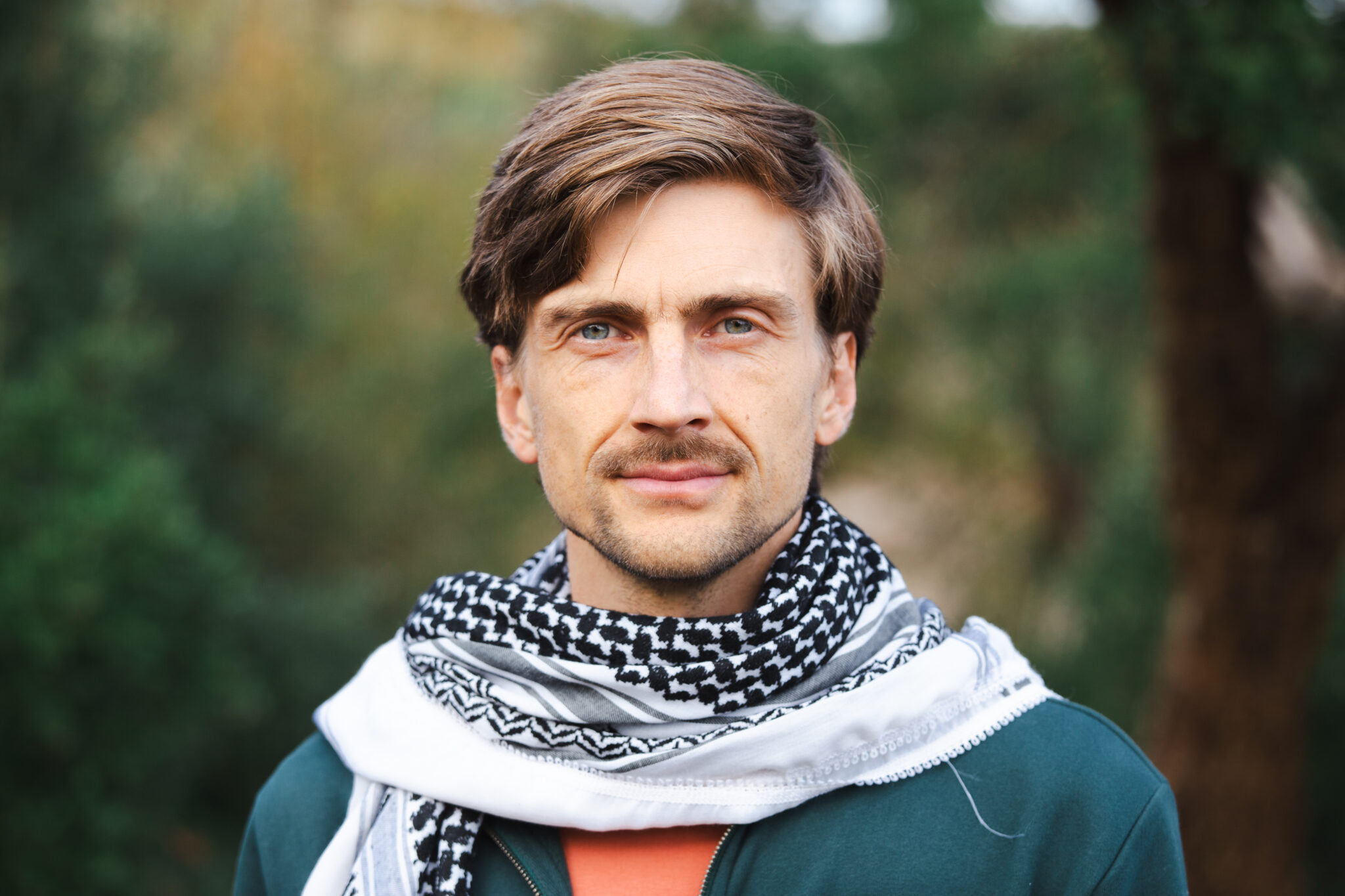
Martin Winiecki is a post-capitalist visionary, educator, writer and activist focusing on internationalist solidarity, intersectional systems change and ecology. For 19 years, he was part of the Tamera community in Portugal where he led international relations and served as next-generation leader. In 2017, inspired by Standing Rock, he co-founded the Defend the Sacred Alliance. He left Tamera last year and continues to co-create initiatives of solidarity, ecology and storytelling projects, including the documentary Water is Love.
To find out more about Martin’s work, visit https://martinwiniecki.org